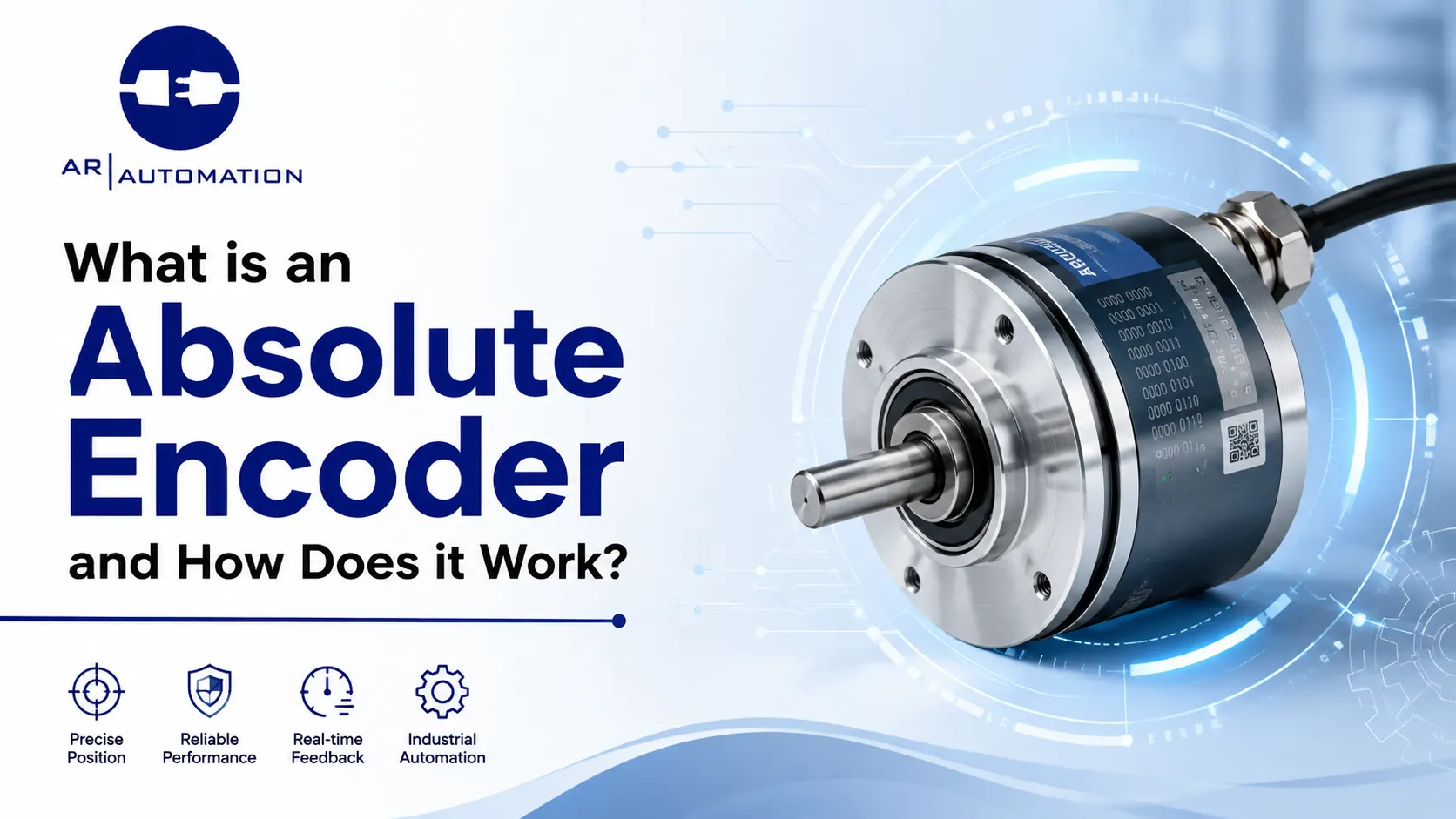
An absolute encoder is one of the important sensing devices used for this purpose. It helps industrial equipment identify the exact position of a rotating shaft and communicate that position to a control system. Unlike some other feedback devices, an absolute encoder can retain position information even when power is removed, depending on its design and memory arrangement. AR Automation provides automation and control solutions for industries that need dependable position sensing and machine feedback. Our company can offer suitable encoder solutions for applications where accuracy, repeatability, and reliable feedback are important.
What Is an Absolute Encoder?
An absolute encoder is an electromechanical feedback device that converts the angular position of a rotating shaft into a unique digital or coded output. Each shaft position corresponds to a specific code, allowing the controller to determine the shaft’s position directly. The encoder is generally mounted to a motor or rotating mechanism. As the shaft rotates, the encoder detects the change in position and sends corresponding feedback to the controller.
Absolute Encoder Working Principle
The absolute encoder working principle is based on detecting the unique position of a rotating shaft and converting it into a coded electrical output. Inside the encoder, a rotating disc or sensing arrangement contains position information. Depending on the encoder technology, this information may be detected optically, magnetically, or through another sensing method.
In an optical design, the encoder disc contains a carefully arranged pattern of transparent and opaque sections. As the disc rotates, a light source and sensing elements detect the pattern. The resulting signals are processed into a unique digital position value.
How Does an Absolute Encoder Work?
The absolute encoder working process can be understood through a few basic stages:
1. Shaft Rotation
The encoder shaft is connected to the rotating component of a machine, such as a motor shaft. When the machine moves, the encoder shaft rotates along with it.
2. Position Detection
A sensing system inside the encoder detects the angular position of the shaft. The sensing technology may be optical, magnetic, or based on another suitable principle.
3. Code Generation
The detected position is converted into a unique digital code. This code represents the specific angular position of the shaft.
4. Signal Transmission
The encoder sends the position information to a PLC, motion controller, servo drive, or other automation system through an appropriate communication interface.
5. Machine Control
The controller uses the feedback to determine whether the machine has reached the required position. It can then adjust motor movement or initiate the next operation.
This continuous feedback allows automated machines to perform positioning tasks with greater precision.
Absolute Encoder vs Incremental Encoder
One of the most common comparisons in industrial automation is between absolute and incremental encoders. An incremental encoder generates pulses as the shaft rotates. The controller counts these pulses to determine movement and position relative to a reference point. If power is interrupted, the system may need to re-establish its reference position depending on the application.
An absolute encoder, on the other hand, provides a unique position value for each shaft position. This means the system can identify the position directly rather than relying solely on pulse counting. The choice between the two depends on the machine’s requirements, control system, accuracy, cost, and operating environment.
Types of Absolute Encoders
Absolute encoders are available in different configurations to suit various industrial applications.
Single-Turn Absolute Encoder
A single-turn encoder measures the position of the shaft within one complete revolution. It is suitable when the application only requires angular position within a single rotation.
Multi-Turn Absolute Encoder
A multi-turn encoder can track shaft position across multiple revolutions. This makes it useful for applications where the shaft travels through more than one complete rotation.
Optical Absolute Encoder
Optical models use light and coded discs to determine shaft position. They can provide high-resolution feedback and are widely used in precision automation.
Magnetic Absolute Encoder
Magnetic models use magnetic sensing technology to determine position. They can be suitable for industrial environments where robustness and resistance to certain operating conditions are important.
Benefits of Absolute Encoders
Using an absolute encoder can provide several advantages in automated machinery:
- Accurate position feedback
- Direct position identification
- Reliable motion control
- Reduced need for homing in suitable applications
- High repeatability
- Support for precise automation
- Availability in single-turn and multi-turn designs
The exact benefits depend on the encoder type, resolution, communication protocol, and machine configuration.
Applications of Absolute Encoders
Absolute encoders are used across a wide range of industries. Typical applications include:
- Robotics
- CNC machines
- Packaging machinery
- Conveyor systems
- Servo motor applications
- Automated assembly machines
- Printing machinery
- Material handling systems
Wherever precise rotary position feedback is required, an absolute encoder can be an important part of the control architecture.
Understanding the absolute encoder working principle makes it easier to see why these devices are widely used in robotics, CNC machinery, servo systems, packaging equipment, and other automated applications. Whether using an optical or magnetic design, single-turn or multi-turn configuration, the right encoder can improve machine control and positioning performance. With suitable engineering guidance, AR Automation can offer practical encoder solutions that help manufacturers build more accurate, reliable, and efficient automated systems. An absolute encoder is an important feedback device for modern industrial automation. By providing a unique position value for the rotating shaft, it allows controllers to understand machine position accurately and support precise movement.