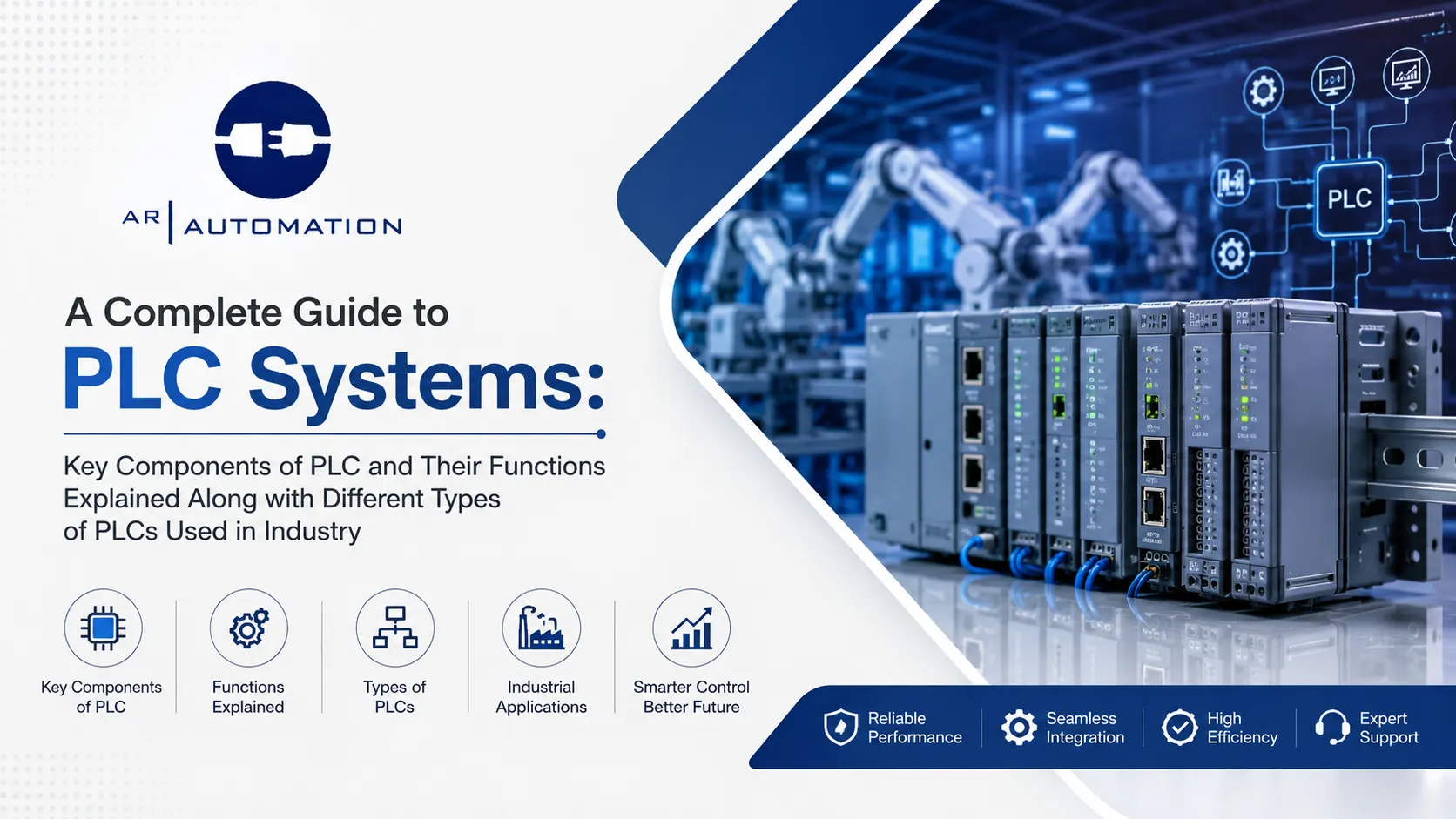
Programmable Logic Controllers (PLCs) have revolutionized industrial automation by providing reliable, flexible, and efficient control solutions for manufacturing and processing industries. From controlling simple machinery to managing complex automated production lines, PLC systems have become an essential part of modern industrial operations. Understanding the components of PLC, their functions, and the various types of PLC available helps industries select the right automation solution for their operational requirements.
At AR Automation, we offer advanced industrial automation solutions and PLC systems designed to improve productivity, operational efficiency, and process reliability across various industries.
What is a PLC System?
A Programmable Logic Controller (PLC) is an industrial computer specifically designed to monitor inputs, process programmed instructions, and control outputs in automated systems. Unlike conventional control systems, PLCs provide flexibility, high reliability, easy programming, and excellent performance in harsh industrial environments.
PLC systems are widely used in manufacturing plants, food processing units, chemical industries, automotive assembly lines, water treatment plants, packaging industries, and power generation facilities.
Components of PLC
To understand how a PLC system works, it is important to learn about the various components of PLC that work together to perform automation tasks efficiently. Each component performs a specific function that contributes to the overall operation of the system.
1. Central Processing Unit (CPU)
The CPU is considered the brain of the PLC system. It processes input signals, executes programmed instructions, and controls output devices. The CPU continuously scans the system to ensure proper operation and real-time decision-making.
Among all main components of PLC, the CPU plays the most critical role in system performance and reliability.
2. Power Supply Unit
The power supply provides electrical energy required for the operation of the PLC system. It converts incoming AC voltage into regulated DC voltage suitable for internal electronic components.
3. Input Module
The input module receives signals from various field devices such as:
- Sensors
- Push buttons
- Switches
- Temperature transmitters
- Pressure sensors
- Proximity sensors
These signals are converted into a format that the PLC processor can understand.
4. Output Module
The output module sends commands from the PLC processor to field devices, including:
- Motors
- Relays
- Solenoid valves
- Alarms
- Indicators
- Contactors
This module enables the PLC to control industrial equipment effectively.
5. Memory Unit
The memory stores:
- User programs
- Operational data
- System configuration
- Temporary processing information
The memory unit is one of the essential plc components required for proper program execution and data retention.
PLC Parts Used in Industrial Automation
Various plc parts work together to ensure reliable automation performance. Depending on the application, additional components may include:
- Expansion modules
- Analog input/output cards
- Motion control modules
- Safety modules
- Ethernet communication cards
- Remote I/O systems
- Programming devices
The selection of appropriate parts of PLC depends on the complexity and requirements of the industrial process.
Types of PLC Used in Industry
There are several types of PLC available for industrial applications. Each plc type offers unique advantages depending on the scale and complexity of automation requirements.
1. Compact PLC
Compact PLCs integrate all essential components into a single unit. They are widely used for small and medium-scale automation systems.
Advantages include:
- Easy installation
- Lower cost
- Compact design
- Simple maintenance
This type of PLC is ideal for standalone machines and small industrial applications.
2. Modular PLC
Modular PLCs consist of separate modules that can be added or removed based on application requirements.
Benefits include:
- High flexibility
- Easy expansion
- Greater processing power
- Advanced communication capabilities
Modular PLC systems are commonly used in large manufacturing facilities.
3. Rack-Mounted PLC
Rack-mounted PLC systems use a chassis or rack structure to accommodate multiple modules.
These plc types provide:
- High scalability
- Large memory capacity
- Extensive input/output capability
- Industrial-grade reliability
They are often used in complex industrial plants and process automation systems.
4. Small PLC
Small PLCs are designed for limited control applications and offer basic automation functionality.
Applications include:
- Packaging machines
- Conveyor systems
- Small manufacturing equipment
- Material handling systems
5. Medium PLC
Medium PLC systems support more complex applications requiring additional I/O points and communication functions.
They are commonly used in:
- Production lines
- Food processing industries
- Pharmaceutical manufacturing
- Textile industries
6. Large PLC
Large PLC systems provide maximum processing capability and are suitable for highly complex industrial operations.
Typical applications include:
- Oil and gas industries
- Chemical plants
- Power generation facilities
- Steel manufacturing plants
Different Types of PLC Based on Output
Another classification of different types of PLC depends on output technology.
1. Relay Output PLC
Uses electromechanical relays for switching loads and offers excellent isolation.
2. Transistor Output PLC
Provides faster switching speeds and is ideal for high-speed automation applications.
3. Triac Output PLC
Used primarily for controlling AC-powered equipment.
Selecting the proper plc type depends on the nature of the industrial load and control requirements.
Advantages of PLC Systems
PLC systems provide numerous benefits to modern industries:
- High reliability
- Easy programming
- Flexible operation
- Reduced maintenance
- Fast processing speed
- Excellent scalability
- Real-time monitoring
- Improved productivity
- Enhanced safety
- Lower operational costs
These advantages have made PLCs the preferred automation technology across industries.
Applications of PLC Systems
PLC systems are widely used in various sectors, including:
- Automotive manufacturing
- Food processing
- Pharmaceutical industries
- Water treatment plants
- Textile manufacturing
- Packaging industries
- Power plants
- Chemical processing
- Material handling systems
- Building automation
The versatility of plc components allows industries to automate virtually any process efficiently.
Why Choose AR Automation?
At AR Automation, we offer advanced PLC solutions tailored to meet the unique requirements of modern industrial operations. Our team provides expert support for PLC selection, programming, installation, integration, and maintenance services. Whether your project requires compact PLC systems, modular automation solutions, or advanced industrial control systems, AR Automation delivers reliable and cost-effective automation solutions designed for maximum operational efficiency.
Conclusion
Understanding the components of PLC, plc parts, and various types of PLC is essential for designing efficient industrial automation systems. The proper selection of plc components and the right plc type can significantly improve productivity, reduce downtime, and enhance operational reliability.
As industrial automation continues to evolve, AR Automation continues to offer innovative PLC solutions that help industries achieve smarter, safer, and more efficient manufacturing operations.