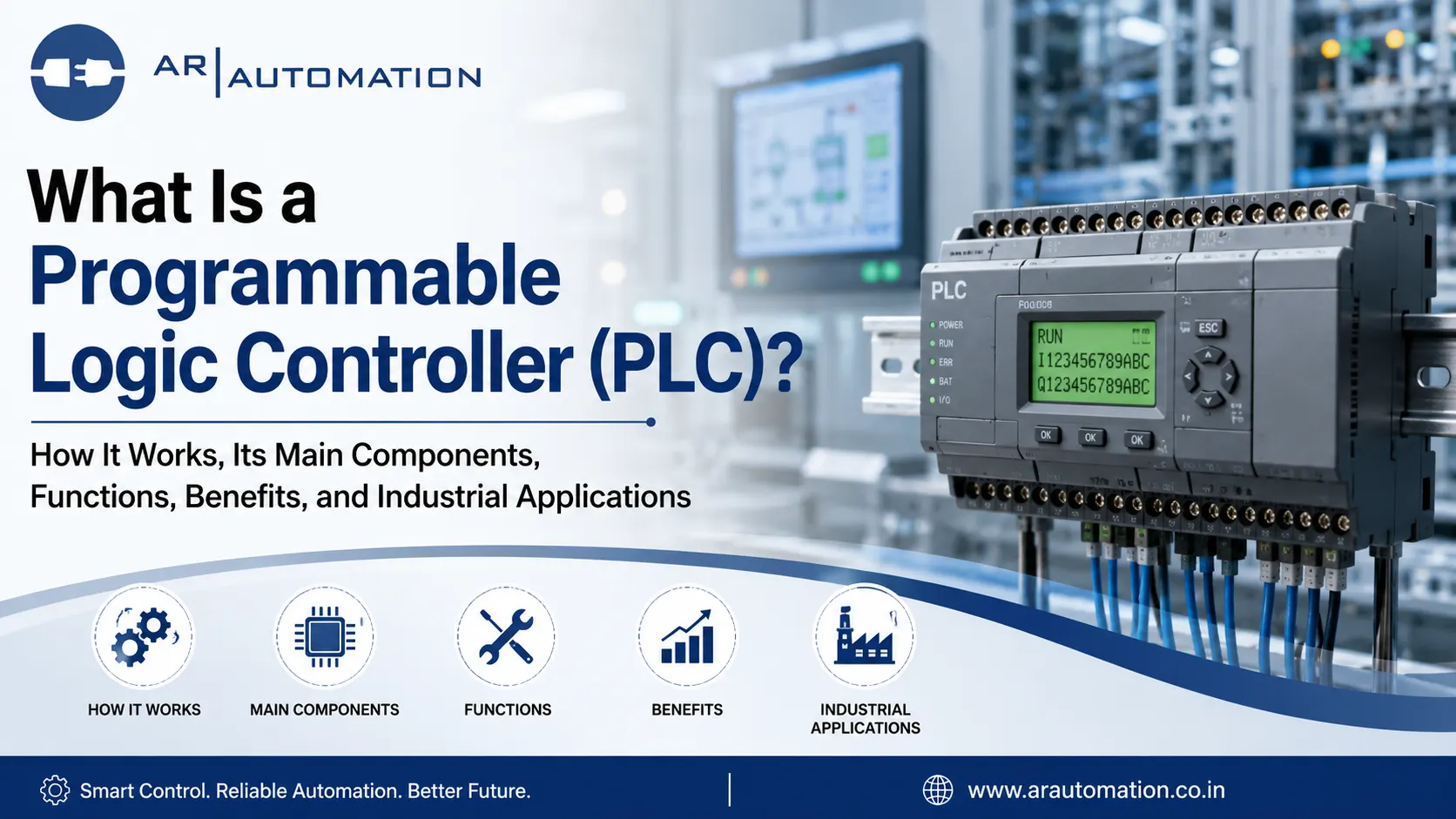
One of the most important technologies behind this transformation is the Programmable Logic Controller (PLC). It helps industries control machines, improve productivity, and maintain consistent operating performance. AR Automation provides industrial automation solutions that support businesses in building efficient and reliable control systems. Understanding PLC technology is useful for manufacturers, engineers, technicians, and business owners who want to improve their automation processes. From controlling conveyor belts to managing complex production lines, PLCs play an important role in modern industrial environments.
What Is a PLC?
A Programmable Logic Controller, commonly known as a PLC, is an industrial digital controller designed to monitor inputs, process programmed instructions, and control outputs. It receives signals from connected devices, evaluates the information according to its program, and sends commands to machines or other equipment.
The PLC meaning becomes easier to understand when you consider a simple example. Imagine a conveyor belt that needs to start when a sensor detects a product and stop when the product reaches a specific position. A PLC can receive the sensor signal, process the programmed conditions, and control the conveyor motor through an appropriate motor starter or drive.
How Does a PLC Work?
A PLC follows a systematic process to control industrial equipment. It continuously monitors connected inputs, executes its control program, and updates its outputs.
The process generally includes three main stages.
- Input Reading: The PLC receives signals from devices such as push buttons, proximity sensors, temperature sensors, limit switches, and pressure transmitters. Depending on the equipment, these signals may be digital or analogue.
- Program Execution: The processor evaluates the input information according to the stored instructions. It determines which actions should take place based on programmed conditions, timers, counters, and other logic.
- Output Control: The PLC updates its outputs to operate equipment such as indicator lamps, relays, solenoid valves, contactors, and motor control systems.
This process repeats continuously during operation. The actual response time depends on factors such as the PLC model, program complexity, communication settings, and input/output configuration.
Main Components of a PLC
Understanding PLC basics starts with learning about the major components that make up the controller.
1. Central Processing Unit (CPU)
The CPU is the main processing unit of a PLC. It executes the control program, processes input information, manages internal memory, and coordinates communication with connected devices.
2. Power Supply
The power supply provides the electrical power required by the PLC and its internal components. Different PLC models support different supply voltages, so the manufacturer’s specifications must be checked before installation.
3. Input Modules
Input modules receive signals from field devices, including switches, sensors, and measuring instruments. They convert incoming signals into information the controller can process.
4. Output Modules
Output modules send control signals to connected equipment. Depending on the application, outputs may operate relays, indicator lights, valves, or motor control devices.
5. Memory
PLC memory stores the control program, configuration information, and relevant operating data. Memory capacity varies according to the controller model and application requirements.
6. Communication Ports
Communication interfaces allow a PLC to exchange information with HMIs, industrial computers, drives, remote I/O modules, and other automation equipment.
PLC Programming
PLC programming is the process of creating instructions that tell a controller how to operate a machine or industrial process. The program defines how the system should respond to different inputs, operating conditions, and events. Several programming languages are used in industrial automation. Ladder Diagram (LD) is popular because its visual structure resembles traditional electrical relay logic. Other languages include Function Block Diagram (FBD), Structured Text (ST), and Sequential Function Chart (SFC).
Functions of a Programmable Logic Controller
PLCs perform several functions that support automated industrial operations.
- Machine Control: They control the starting, stopping, and sequencing of industrial machinery.
- Timer and Counter Operations: They manage time-dependent actions and count products, machine cycles, or other events.
- Process Monitoring: They receive information from sensors and monitor parameters such as temperature, pressure, and liquid levels.
- Alarm Management: They can identify configured abnormal conditions and activate alarms or notifications.
- Communication: They exchange information with HMIs, supervisory control systems, and compatible industrial devices.
These functions make PLCs suitable for both simple machine automation and complex manufacturing processes.
Benefits of Using PLCs
PLCs offer several advantages for businesses that want to improve their production systems.
- Improved Reliability: Industrial controllers are designed for dependable operation in demanding environments when installed and maintained correctly.
- Flexible Control: Programs can be modified to accommodate changes in machine sequences and production requirements.
- Reduced Manual Intervention: Automated control reduces the need for operators to perform repetitive actions manually.
- Easier Troubleshooting: Diagnostic indicators, monitoring tools, and alarms can help technicians identify faults more efficiently.
- Consistent Production: PLCs can execute programmed sequences repeatedly, helping maintain consistent machine operation.
- System Integration: Compatible PLCs can communicate with drives, HMIs, sensors, and other automation equipment to create coordinated control systems.
A Programmable Logic Controller is a fundamental part of modern industrial automation. By receiving signals, processing instructions, and controlling connected equipment, it helps businesses improve production consistency, reduce repetitive manual work, and manage machines efficiently.
Understanding PLC basics, the PLC meaning, and the importance of PLC programming makes it easier to identify suitable automation solutions. AR Automation aims to offer practical industrial automation solutions that help businesses plan reliable control systems and support their long-term production goals.