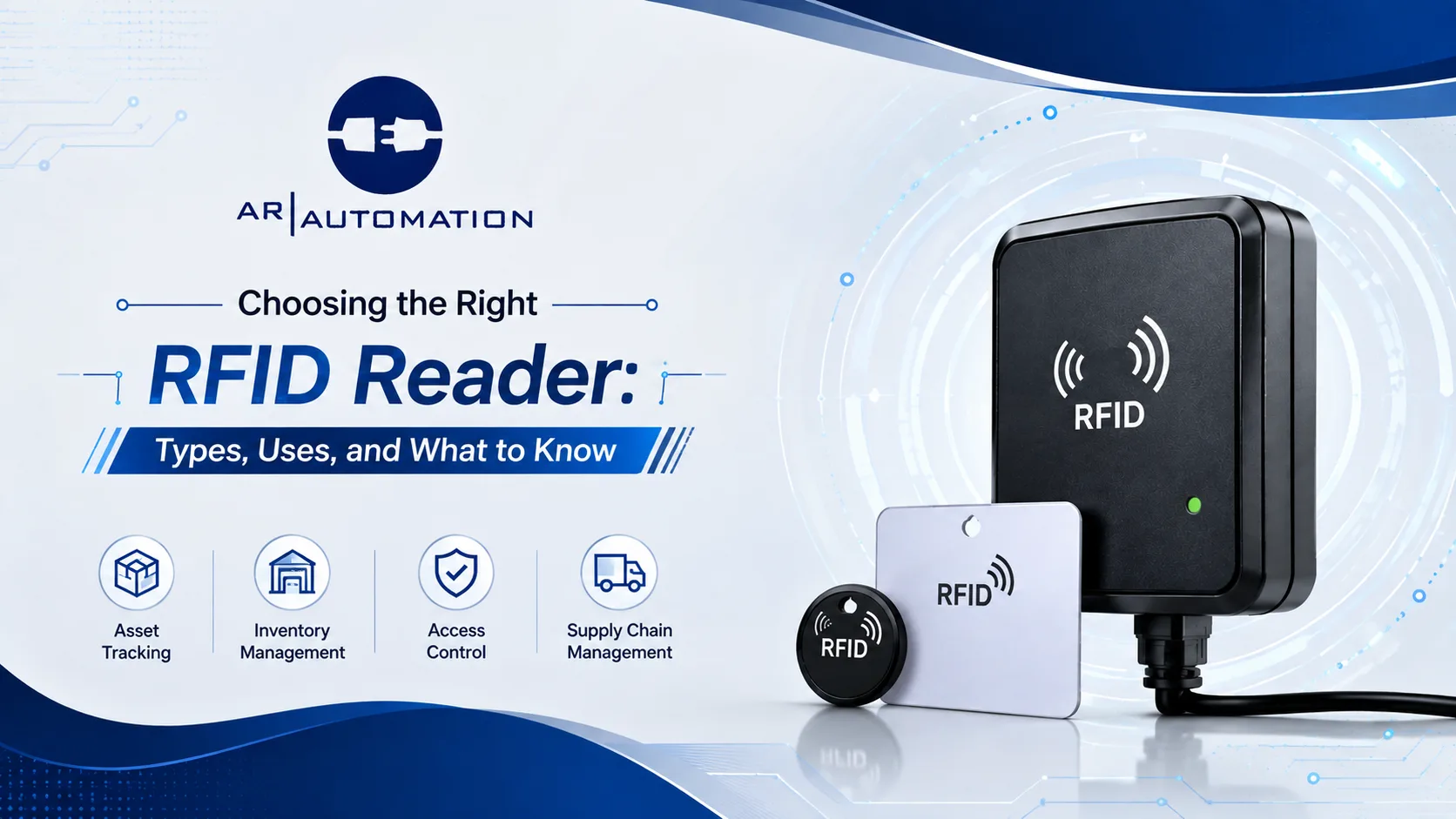
Radio Frequency Identification (RFID) technology has transformed the way businesses track, monitor, and manage assets. From retail stores and warehouses to hospitals and manufacturing units, RFID systems help improve operational efficiency by enabling fast and accurate data collection. At the heart of every RFID system is the RFID reader, a device responsible for communicating with RFID tags and collecting information in real time.
AR Automation is one of the trusted RFID reader manufacturers in India, offering advanced RFID solutions designed to improve inventory management, asset tracking, access control, and industrial automation.
What is RFID Reader?
An RFID reader is an electronic device that communicates wirelessly with RFID tags using radio waves. It sends signals to nearby RFID tags, receives the stored information, and transfers the collected data to a computer or management system for processing.
Unlike barcode scanners, RFID gate reader do not require a direct line of sight. Multiple tags can be read simultaneously, making the technology faster, more accurate, and more efficient for high-volume operations.
How Do RFID Readers Work?
An RFID reader contains an antenna that emits radio frequency signals. When an RFID tag enters the reader’s range, the radio waves activate the tag. The tag then transmits its unique identification data back to the reader.
The reader processes this information and sends it to software that displays, records, or analyzes the data. Depending on the application, the system can instantly identify products, monitor inventory, track assets, or control access. This entire process takes only a fraction of a second, allowing businesses to manage thousands of items quickly and accurately.
Types of RFID Readers
Choosing the correct device begins with understanding the different types of RFID readers available in the market. Each type is designed for specific environments and applications.
1. Fixed RFID Readers
Fixed readers are permanently installed at entrances, exits, production lines, or warehouse gates. They continuously monitor RFID tags that pass through their reading zone.
2. Handheld RFID Readers
Portable handheld readers allow operators to scan RFID tags while moving around a facility. They are ideal for stock verification, warehouse audits, retail inventory, and field inspections.
3. Desktop RFID Readers
Desktop readers are compact devices commonly used in offices, laboratories, libraries, and access control systems. They provide reliable tag reading over short distances and are easy to integrate with computer systems.
4. Integrated RFID Readers
Integrated readers combine the reader and antenna into a single unit, making installation simpler and reducing wiring requirements. These are widely used in industrial automation and smart manufacturing applications.
Understanding these RFID reader types helps businesses choose the most suitable solution based on their operational needs.
RFID Reader Types Based on Frequency
Another way to classify RFID reader types is by operating frequency.
Low Frequency (LF)
Low-frequency readers operate over shorter distances and are commonly used for animal identification and access control.
High Frequency (HF)
HF readers are widely used for smart cards, ticketing systems, libraries, and payment applications.
Ultra High Frequency (UHF)
UHF readers provide longer reading distances and faster scanning speeds, making them ideal for logistics, warehouses, retail, and supply chain management.
Selecting the right frequency depends on the required reading distance, environmental conditions, and application.
Applications of RFID Readers
RFID technology is used across numerous industries due to its speed, accuracy, and reliability.
Common applications include:
- Inventory management
- Warehouse automation
- Retail stock control
- Manufacturing tracking
- Asset management
- Vehicle identification
- Attendance systems
- Library management
- Hospital equipment tracking
- Access control
These applications demonstrate why RFID has become an essential technology for modern businesses.
Benefits of RFID Readers
Businesses continue adopting RFID technology because of its many advantages.
Some key benefits include:
- Faster inventory management
- Improved operational efficiency
- Accurate asset tracking
- Reduced manual errors
- Real-time visibility
- Enhanced security
- Lower labor costs
- Better customer service
- Increased productivity
These benefits help organizations improve workflow while making data collection faster and more reliable.
Why Choose AR Automation?
When selecting among leading RFID reader manufacturers, choosing an experienced supplier is essential. AR Automation offers advanced RFID solutions tailored to the needs of industries such as manufacturing, logistics, retail, healthcare, education, and warehousing. With a focus on innovation and quality, AR Automation delivers RFID systems that help businesses improve efficiency, accuracy, and operational control.
Whether you need a fixed, handheld, desktop, or integrated device, selecting the appropriate RFID reader types ensures reliable performance and long-term value. If you are looking for dependable RFID reader manufacturers, AR Automation can offer high-quality RFID readers and customized automation solutions designed to meet the demands of modern industries. Our advanced technology, expert support, and commitment to quality make them a trusted partner for businesses seeking efficient and scalable RFID systems.