Encoders play a crucial role in modern industrial automation by providing accurate feedback for position, speed, and direction control. They are widely used in CNC machines, robotics, conveyors, packaging equipment, printing machines, elevators, and many other automated systems. Understanding the types of encoder available helps industries choose the right solution for their applications. Among the most commonly used encoder types are absolute encoders and incremental encoders, each offering unique advantages depending on operational requirements.
AR Automation is a trusted provider of high-quality encoder solutions designed to improve machine accuracy and productivity. Our company continues to offer reliable automation products that meet the demanding needs of various industries.
What Are Encoders?
An encoder is an electromechanical device that converts rotational or linear motion into electrical signals. These signals are transmitted to controllers, PLCs, or motion control systems, enabling precise monitoring and control of machine movement.
There are several types of encoders available, but the two most widely used are:
- Absolute Encoders
- Incremental Encoders
Understanding these encoder types is essential when selecting the right feedback device for industrial automation systems.
Types of Encoder Used in Industry
There are different types of encoder designed for various automation applications.
1. Incremental Encoder
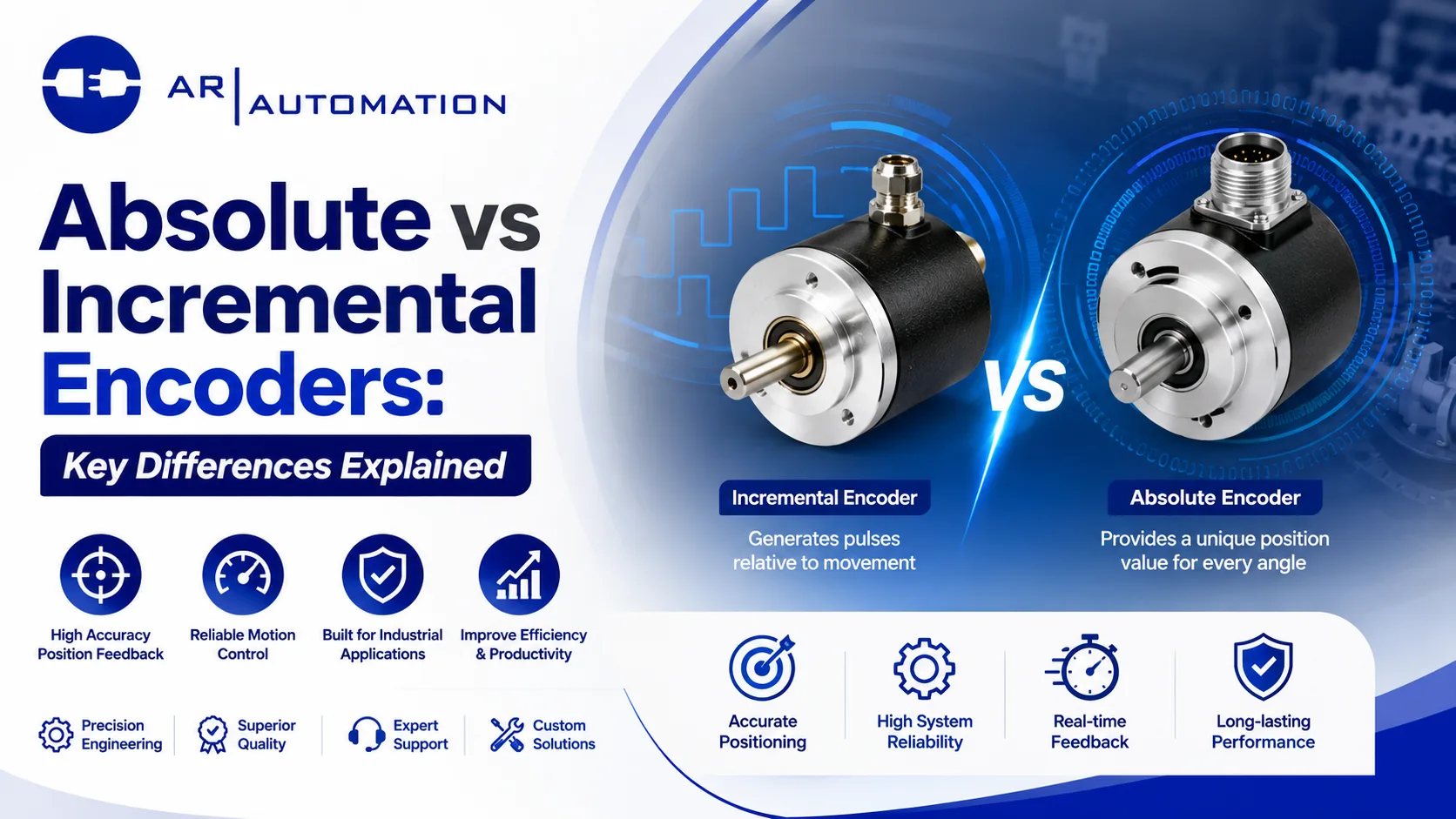
An incremental encoder generates a series of electrical pulses as the shaft rotates. The controller counts these pulses to determine speed, direction, and relative position. If the system loses power, the position information is lost and must be re-established through a reference or home position.
Incremental encoders are widely used because they are economical, reliable, and suitable for high-speed motion control applications.
2. Absolute Encoder
An absolute encoder assigns a unique digital value to every shaft position. Even after a power failure, the encoder retains the exact shaft position without requiring a homing procedure. These encoders are ideal for applications where precise positioning and uninterrupted feedback are essential.
Among all types of encoders, absolute encoders are preferred for highly accurate positioning systems, while incremental encoders remain the most popular choice for general automation.
Absolute Encoder vs Incremental Encoder
The comparison of absolute encoder vs incremental encoder is one of the most common topics in industrial automation. Although both devices measure rotational movement, their operating principles differ significantly.
Position Tracking
An absolute encoder always knows the exact shaft position, even after power loss. In contrast, an incremental encoder only tracks movement relative to a starting point and requires homing after a restart.
Power Interruption
During a power failure, an absolute encoder preserves position data. An incremental encoder loses its position information and must be reset before operation resumes.
Accuracy
Both encoder types provide excellent accuracy. However, absolute encoders are generally preferred for applications requiring continuous position tracking without interruption.
Cost
Incremental encoders are generally more affordable and easier to integrate, while absolute encoders involve higher initial investment due to their advanced technology.
System Complexity
Incremental encoders have simpler wiring and installation requirements. Absolute encoders often require more advanced communication protocols and controller compatibility.
Understanding absolute encoder vs incremental encoder helps engineers choose the most suitable solution based on operational requirements and budget.
Difference Between Incremental and Absolute Encoder
| Feature | Incremental Encoder | Absolute Encoder |
|---|---|---|
| Position Memory | Lost after power failure | Retained after power failure |
| Homing Required | Yes | No |
| Signal Output | Pulse-based | Unique digital position code |
| Cost | Lower | Higher |
| Installation | Simple | More advanced |
| Best For | Speed measurement and motion control | Precise position control |
Applications of Incremental Encoders
Incremental encoders are commonly used in:
- Conveyor systems
- Packaging machines
- Textile machinery
- Printing equipment
- Material handling systems
- CNC machines
- Servo motors
- Industrial automation
- Robotics
These applications benefit from fast response, simple integration, and cost-effective performance.
Applications of Absolute Encoders
Absolute encoders are widely used in:
- CNC machining centers
- Robotic arms
- Medical equipment
- Aerospace systems
- Automated storage systems
- Industrial cranes
- Elevator positioning
- Wind turbines
- Precision manufacturing
These applications require accurate position feedback even after unexpected power interruptions.
Why Choose AR Automation?
AR Automation is committed to delivering reliable automation products for industries across multiple sectors. The company continues to offer precision-engineered encoder solutions designed to improve machine performance and operational efficiency. With years of experience in industrial automation, AR Automation helps customers achieve accurate motion control and long-term reliability.
Understanding the types of encoder available is essential for selecting the right feedback device for industrial automation. Among the various encoder types, the comparison of absolute encoder vs incremental encoder highlights two highly effective technologies with distinct advantages. While incremental encoders provide an economical solution for speed and motion control, absolute encoders deliver precise position tracking even after power loss. Whether your project requires basic motion feedback or advanced positioning control, AR Automation continues to offer dependable encoder solutions that enhance productivity, accuracy, and overall system performance.