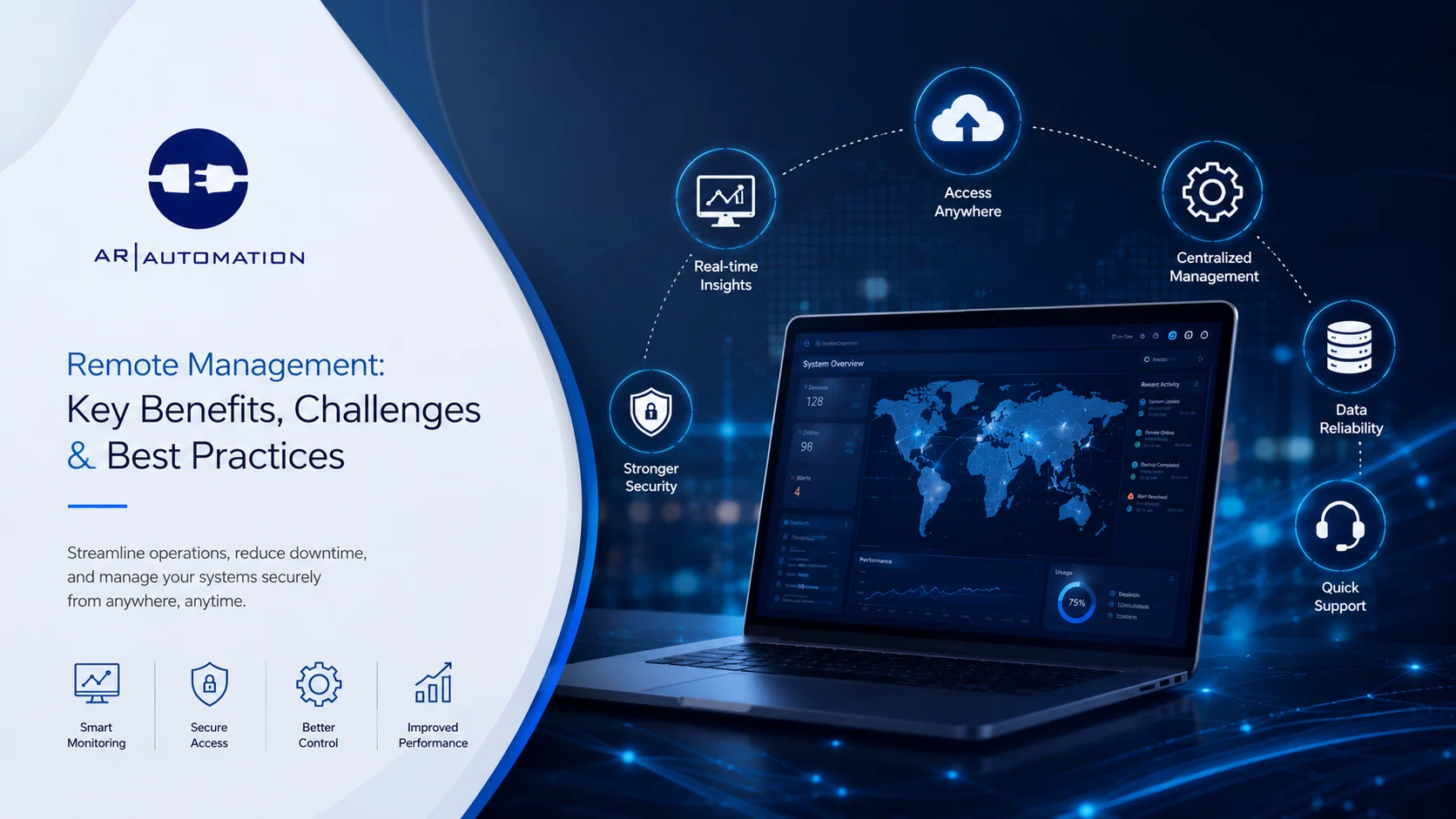
In today’s fast-paced digital world, businesses depend heavily on technology to maintain productivity, security, and operational efficiency. As organizations expand across multiple locations and employees work from different regions, managing systems and networks manually becomes increasingly difficult. This is where remote management plays a crucial role. It enables businesses to monitor, control, and maintain IT infrastructure from virtually anywhere, ensuring smooth operations without requiring on-site intervention.
AR Automation offers advanced solutions that help organizations streamline operations through efficient remote management practices, improving productivity while reducing operational costs.
What is Remote Management?
Remote management refers to the ability to monitor, control, maintain, and troubleshoot devices, networks, software, and systems from a remote location. Instead of being physically present at a site, administrators can access systems through secure internet connections and management tools.
Organizations use remote management to supervise servers, industrial automation systems, computers, IoT devices, security systems, and communication networks. Modern businesses increasingly depend on remote network management and remote system management solutions to ensure continuous operation and minimize downtime.
Importance of Remote Management in Modern Businesses
Technology infrastructure has become more complex than ever before. Organizations often operate multiple branches, warehouses, production facilities, and remote offices.
Remote management helps businesses:
- Monitor operations in real time
- Improve system performance
- Reduce maintenance costs
- Increase productivity
- Enhance cybersecurity
- Minimize downtime
- Support business continuity
With the ability to remotely manage critical systems, companies can make faster decisions and respond more effectively to operational challenges.
Key Benefits of Remote Management
- Improved Operational Efficiency: IT teams can access systems instantly without traveling to physical locations. This reduces response times and enables faster issue resolution.
- Reduced Downtime: Remote monitoring tools continuously track system health and alert administrators when issues arise. Using remote system management, businesses can quickly diagnose problems and implement solutions before they become major disruptions.
- Cost Savings: Travel expenses, on-site maintenance visits, and manual inspections can significantly increase operational costs. Remote management reduces the need for physical intervention and lowers maintenance expenses. Companies can remotely manage multiple sites from a centralized location, reducing labor and operational costs.
- Enhanced Security: Cybersecurity threats continue to evolve, making proactive security management essential. Remote management solutions allow administrators to monitor security events, install updates, and enforce policies from anywhere.
- Better Resource Utilization: Remote access allows technical teams to focus on strategic tasks rather than routine maintenance activities. Automated monitoring and alerts further improve resource allocation and workforce productivity.
Applications of Remote Management
Remote management is widely used across multiple industries and business environments.
- Industrial Automation: Manufacturing facilities use remote management systems to monitor machinery, production lines, and industrial equipment. Engineers can access real-time data and optimize operations without visiting the plant.
- Information Technology: IT departments use remote system management tools to maintain servers, workstations, and software applications across multiple locations.
- Smart Buildings: Building management systems use remote access technology to control HVAC systems, lighting, energy consumption, and security devices.
- Healthcare: Hospitals and healthcare facilities use remote monitoring solutions to manage medical equipment and critical infrastructure.
- Retail and Commercial Operations: Retail chains can remotely manage point-of-sale systems, inventory management tools, and communication networks from a central office.
Best Practices for Effective Remote Management
- Implement Strong Access Controls: Use multi-factor authentication, secure passwords, and role-based permissions to protect systems from unauthorized access.
- Regularly Update Systems: Keeping software and firmware up to date helps protect against vulnerabilities and improves system performance.
- Monitor Network Activity: Continuous monitoring enables organizations to identify suspicious activity and respond quickly to security incidents.
- Use Reliable Management Platforms: Selecting a trusted remote management solution ensures better performance, scalability, and security.
- Maintain Data Backups: Regular backups protect valuable information and support disaster recovery efforts.
- Train Employees: Providing proper training helps teams understand security protocols and management procedures.
The Future of Remote Management
The future of remote management is closely connected with advancements in cloud computing, artificial intelligence, Industrial IoT, and automation technologies. Smart monitoring systems are becoming more intelligent, allowing organizations to predict failures, automate maintenance tasks, and optimize operations in real time.
Conclusion
Remote Management has become an essential component of modern business operations. From improving efficiency and reducing costs to enhancing security and minimizing downtime, the benefits are significant. Whether managing industrial equipment, IT infrastructure, or enterprise networks, organizations can achieve greater operational visibility and control through effective remote managing practices.
AR Automation offers innovative solutions that help businesses implement reliable remote management systems tailored to their unique requirements. By leveraging advanced technologies and following proven best practices, organizations can confidently remotely manage their critical assets while ensuring long-term success and operational excellence.