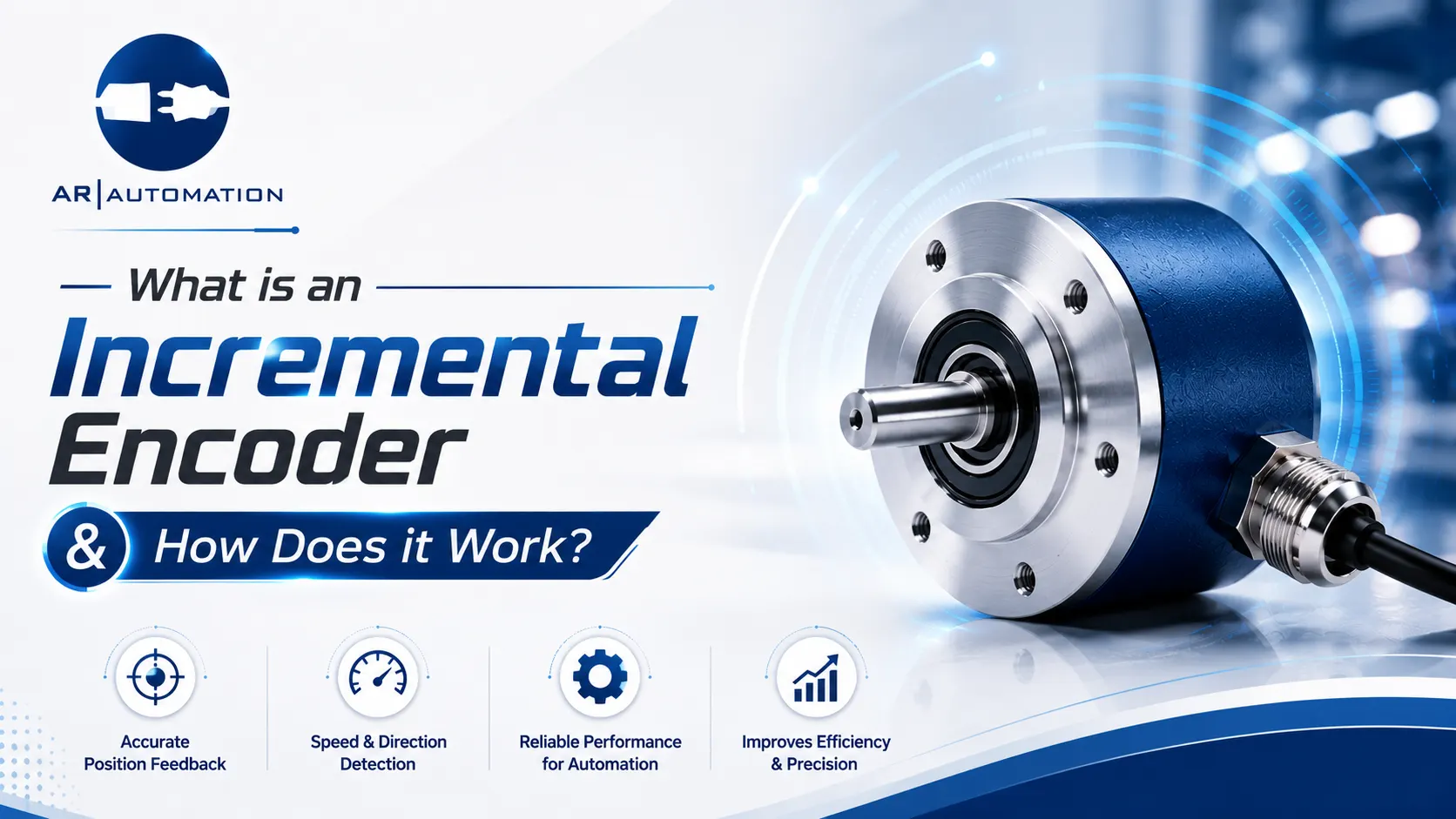
AR Automation is a trusted provider of industrial automation solutions, we offer advanced motion control and sensing technologies for various industries. It is widely used position feedback devices in automation systems as the incremental encoder. These devices play a critical role in monitoring speed, position, and rotational movement in machines, ensuring precision and efficiency in industrial operations. From CNC machines and conveyor systems to robotics and packaging equipment, incremental encoders are essential for accurate motion control.
What is an Incremental Encoder?
An incremental encoder is an electromechanical device that converts rotary motion into electrical signals. Unlike absolute encoders that provide a unique position value at all times, an incremental encoder generates pulses as the shaft rotates. The control system counts these pulses to track movement from a known starting point. The most common type used in industrial applications is the incremental rotary encoder, which is designed to measure rotational motion with high accuracy and reliability.
How Does an Incremental Encoder Work?
The working principle of an incremental encoder is relatively simple yet highly effective.
Inside the encoder, there is a rotating disk attached to the shaft. This disk contains evenly spaced slots or markings. As the shaft rotates, sensors detect these markings and generate electrical pulses.
The process works as follows:
- The shaft rotates.
- The encoder disk moves along with the shaft.
- Optical or magnetic sensors detect the movement of slots or magnetic poles.
- Electrical pulses are generated.
- The controller counts the pulses to determine position and speed.
Because the pulses are generated incrementally during movement, the device is called an incremental encoder.
Components of an Incremental Rotary Encoder
A typical incremental rotary encoder consists of several key components:
- Rotating Shaft: The shaft is connected to the machine component whose motion needs to be monitored.
- Encoder Disk: The disk contains slots, lines, or magnetic markings that create pulse signals when rotating.
- Sensor System: Optical or magnetic sensors detect movement and convert it into electrical signals.
- Output Electronics: These circuits process the detected signals and transmit pulse outputs to the control system.
- Housing: A durable enclosure protects internal components from dust, moisture, vibration, and industrial environments.
Advantages of Incremental Encoders
There are several reasons why industries prefer using an incremental rotary encoder in automation systems.
- High Accuracy: Incremental encoders provide precise motion feedback, helping maintain product quality and machine performance.
- Cost-Effective Solution: Compared to some advanced positioning systems, an incremental encoder offers excellent performance at a competitive cost.
- Easy Integration: Most industrial control systems can easily process encoder pulse signals.
- Reliable Performance: Modern encoder designs ensure stable operation even in demanding industrial environments.
- Real-Time Motion Monitoring: An incremental rotary encoder continuously tracks movement, making it ideal for dynamic applications.
Applications of Incremental Encoders
Incremental encoders are widely used across numerous industries.
- CNC Machines: Machine tools use encoder feedback to achieve precise cutting and positioning operations.
- Robotics: Robotic systems rely on incremental encoder technology to monitor joint movement and control positioning.
- Conveyor Systems: Encoders help maintain consistent speed and synchronization throughout production lines.
- Packaging Equipment: Packaging machines use encoder feedback for labeling, filling, and sealing operations.
- Printing Machines: Printing systems depend on accurate speed control and registration, which an incremental rotary encoder can provide.
- Material Handling Systems: Encoders help track movement and positioning of automated handling equipment.
Difference Between Incremental and Absolute Encoders
A common question is how an incremental encoder differs from an absolute encoder.
An incremental encoder provides relative position information by generating pulses during movement. If power is lost, the system must establish a reference position again when restarted.
An absolute encoder, on the other hand, stores a unique position value for every shaft location and retains position information even after power loss.
While absolute encoders are suitable for certain advanced applications, the incremental rotary encoder remains a popular choice due to its simplicity, affordability, and effectiveness.
Factors to Consider When Choosing an Incremental Encoder
Selecting the right encoder depends on several factors:
- Required resolution and accuracy
- Operating environment
- Shaft size and mounting style
- Output signal type
- Maximum rotational speed
- Environmental protection rating
Careful selection ensures reliable operation and long-term performance.
The incremental encoder is one of the most important feedback devices used in modern industrial automation. By converting rotary motion into electrical pulses, it enables accurate monitoring of speed, direction, and position. Whether used in robotics, packaging machinery, conveyors, or CNC equipment, the incremental rotary encoder helps improve productivity, precision, and machine efficiency.
AR Automation continues to offer high-quality automation solutions that support the growing needs of modern industries. With reliable encoder technologies and expert automation support, businesses can achieve better control, enhanced performance, and greater operational accuracy across a wide range of applications.