
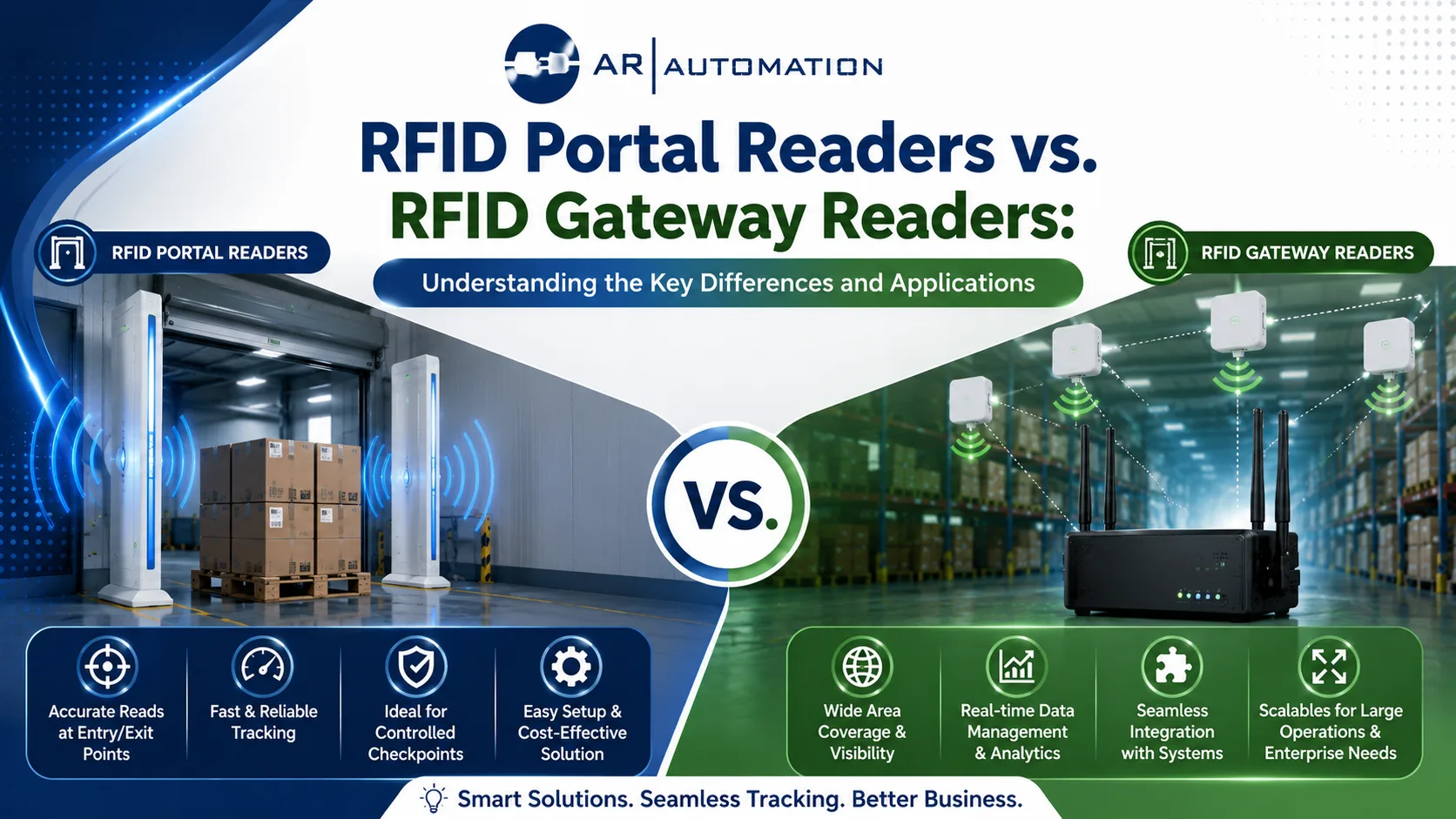
RFID technology has become an essential tool for improving asset tracking, inventory management, and operational efficiency. Businesses across manufacturing, warehousing, retail, healthcare, and transportation sectors depend on RFID systems to automate data collection and enhance visibility throughout their operations. Two commonly used RFID solutions are the rfid portal reader and rfid gateway reader. While both are designed to capture RFID tag information, they serve different purposes and are used in different scenarios.
At AR Automation, we offer advanced RFID solutions tailored to the unique requirements of modern businesses. Understanding the differences between RFID portal readers and RFID gateway readers can help organizations choose the right technology for their operational needs.
What is an RFID Portal Reader?
An rfid portal reader is a fixed RFID reading system typically installed at entry and exit points, doorways, dock doors, or checkpoints. It consists of RFID readers, antennas, and supporting structures that create a controlled reading zone.
When tagged items pass through the portal, the system automatically detects and records the RFID tags without requiring manual scanning.
What is an RFID Gateway?
An rfid gateway is a broader RFID solution designed to monitor and manage the movement of tagged items across larger areas or multiple access points. Unlike a portal reader that focuses on a single passageway, an RFID gateway can integrate multiple readers and antennas to create an intelligent tracking network.
An RFID gateway not only captures RFID data but also processes, filters, and communicates information to enterprise software systems. It acts as a bridge between RFID hardware and business applications.
Applications of RFID Gateway Systems
- Smart Warehousing: An RFID gateway enables comprehensive inventory visibility by collecting data from multiple RFID readers installed throughout the warehouse.
- Logistics and Transportation: RFID gateways support vehicle tracking, cargo monitoring, and fleet management by connecting multiple RFID checkpoints across transportation networks.
- Industrial Automation: Modern factories use RFID gateways to automate material flow tracking, production monitoring, and asset management.
- Healthcare Facilities: Hospitals use RFID gateway solutions to track medical equipment, pharmaceuticals, and patient-related assets across different departments.
Applications of RFID Portal Readers
- Warehouse Management: An rfid portal reader installed at warehouse dock doors can automatically record incoming and outgoing inventory. This reduces manual scanning and improves inventory accuracy.
- Manufacturing Operations: Manufacturers use portal readers to track work-in-progress items as they move between production stages.
- Retail Distribution: Distribution centers use RFID portal readers to verify shipments and ensure order accuracy before products are dispatched.
- Asset Tracking: Organizations can monitor valuable assets as they enter or leave secured areas, helping reduce losses and improve accountability.
Differences Between RFID Portal Readers and RFID Gateway Readers
| Feature | RFID Portal Reader | RFID Gateway Reader |
|---|---|---|
| Coverage Area | Monitors a specific entry or exit point. | Covers larger areas and multiple access points. |
| Purpose | Tracks tagged items passing through a defined checkpoint. | Manages and monitors RFID data across an entire facility. |
| System Complexity | Simple setup with reader and antennas. | More advanced system with integrated readers, software, and data processing. |
| Data Processing | Primarily captures and transmits tag data. | Filters, analyzes, and manages RFID information in real time. |
| Best Applications | Warehouses, dock doors, and inventory checkpoints. | Smart factories, logistics hubs, and enterprise asset tracking systems. |
Key Differences Between RFID Portal Readers and RFID Gateway Readers
1. Coverage Area
An rfid portal reader is designed for a specific entry or exit point. It creates a defined read zone where tagged items are detected as they pass through.
An rfid gateway, on the other hand, can monitor larger spaces and multiple access points simultaneously. It offers broader coverage and can support complex facility-wide tracking systems.
2. System Complexity
RFID portal readers are generally simpler to install and configure. They focus on reading tags at a designated checkpoint and transmitting data to a central system.
An RFID gateway is often more sophisticated. It may include multiple readers, antennas, middleware, and software integration tools that work together to manage RFID data across an entire operation.
3. Data Processing Capabilities
A standard rfid portal reader primarily captures tag information and sends it to the management system.
An rfid gateway performs additional functions such as:
- Data filtering
- Event management
- Device monitoring
- Real-time analytics
- Enterprise software integration
This makes RFID gateways suitable for organizations that require advanced data management and automation.
4. Scalability
RFID portal readers are ideal for specific checkpoints and localized tracking requirements.
RFID gateways offer greater scalability and can be expanded as business operations grow. Additional readers and antennas can be connected to the gateway infrastructure, making it easier to support larger facilities.
5. Cost Considerations
Since portal readers are generally simpler systems, they often involve lower installation and maintenance costs.
RFID gateways may require a larger investment due to their advanced capabilities, extensive coverage, and integration features. However, the long-term operational benefits often justify the investment for large-scale applications.
Both the rfid portal reader and rfid gateway play important roles in modern RFID-based tracking systems. Portal readers excel at monitoring defined entry and exit points, while RFID gateways deliver broader visibility, advanced data management, and enterprise-level scalability.
At AR Automation, we offer innovative RFID solutions that help businesses improve operational efficiency, reduce manual processes, and achieve real-time visibility across their operations. By understanding the unique strengths of RFID portal readers and RFID gateway systems, organizations can make informed decisions and maximize the value of their RFID investments.